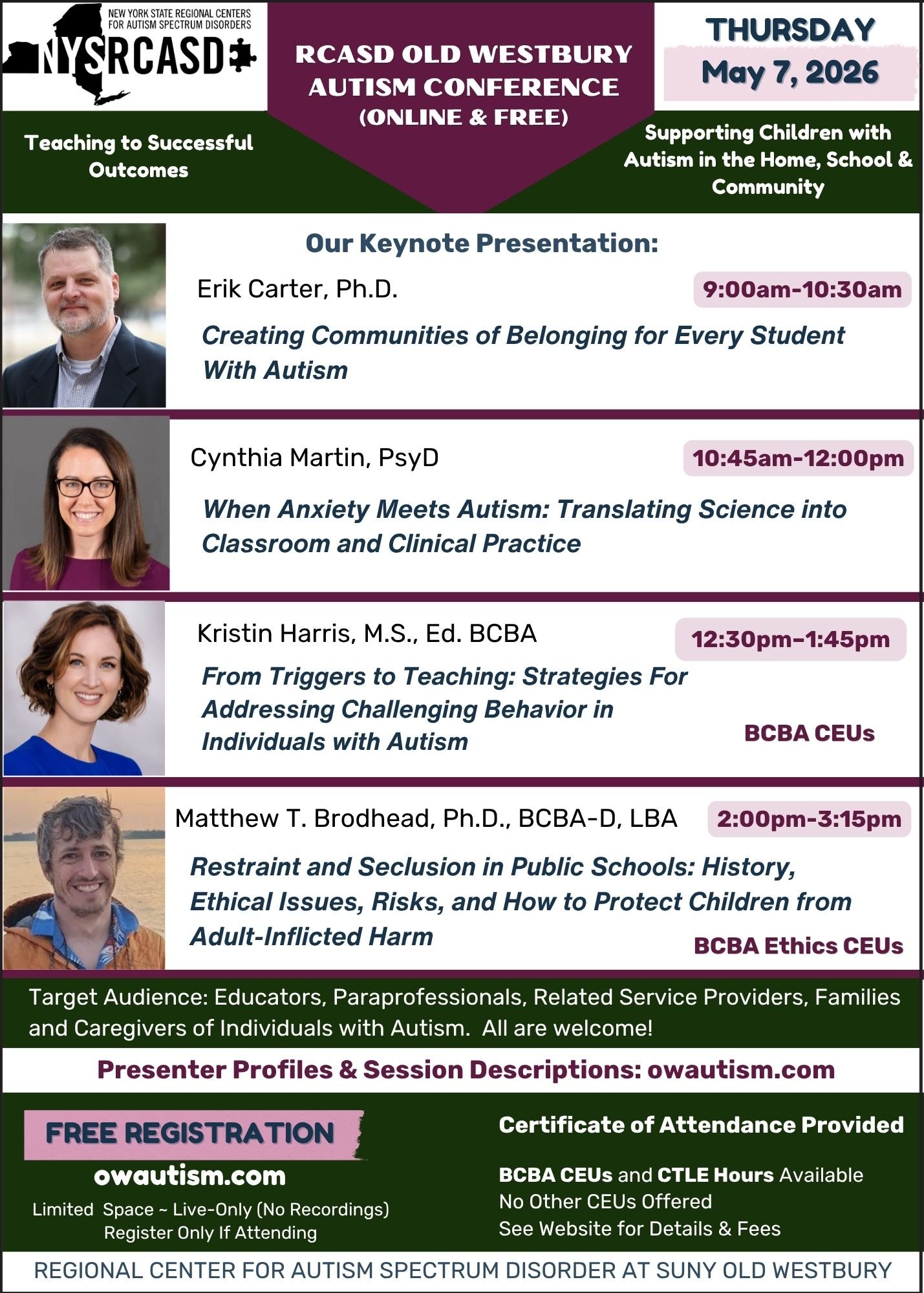
May 7, 2026 Autism Conference on Zoom
Teaching to Successful Outcomes: Supporting Children with Autism in the Home, School and Community
Join us on Thursday, May 7th for our free autism conference on Zoom. Open to all families, educators, administrators, paraprofessionals, related service providers, caregivers, students, and individuals with autism.
Certificates of Attendance:
A certificate of attendance will be issued to ALL attendees. Attendance is usually verified within 72 hours of the event. Surveys are then emailed out to all attendees. A certificate of attendance is generated automatically upon completion of the surveys.
Continuing Education Information:
We are offering CEUs (for BACBs only) and Continuing Teacher & Leader Education hours (CTLEs) for this conference. Eligibility is verified after review of system generated attendance reports and data.
Continuing Teacher and Leader Education (CTLEs):
SUNY Old Westbury is recognized by the New York State Education Department's Office of Teaching Initiatives as an approved provider of CTLE for Professional Classroom Teachers, School Leaders and Level III Teaching Assistants. A total of up to 5.25 CTLE hours are available for this conference. The total fee for CTLEs is $2.50 per session and is payable at time of registration.
Behavior Analyst Certification Board:
SUNY Old Westbury is recognized as an approved provider of BACB CEUs. The cost is $10 per credit payable at the time of registration. Up to 3 credits are available for this conference. BACB CEUs are offered for the following sessions:
Session 3: From Triggers to Teaching: Strategies For Addressing Challenging Behavior in Individuals with Autism (1.5 credits $15).
Session 4: Restraint and Seclusion in Public Schools: History, Ethical Issues, Risks, and How to Protect Children from Adult-Inflicted Harm (1.5 Ethics credits $15)
NO OTHER CEUs being offered at this conference.
Registration Reminders:
Select the sessions you would like to attend from the drop-down menus when registering.
Confirmation emails are sent automatically after registration. Please allow 24 hours to receive your confirmation. If you do not see the email in your inbox, please check your spam folder. Contact us at autism@oldwestbury.edu with any questions.
Use the same first and last name and email address when logging onto Zoom for attendance purposes.
This is a live-only event with NO access to recordings after the conference ends. Please, only register if you plan to attend.
Session Descriptions:
Session 1. 9:00am-10:30am EST
Creating Communities of Belonging for Every Student With Autism
Students learn best and flourish most when they know they belong. Yet, many schools still struggle to become places of widespread and meaningful inclusion for children and youth with autism. Dr. Carter will share a powerful framework for reflecting upon and fostering belonging within our classrooms and schools. Together, we will explore the implications of this work on the ways we welcome, support, educate, and embrace students with and without disabilities alike.
Session 2. 10:45am-12:00pm EST
When Anxiety Meets Autism: Translating Science into Classroom and Clinical Practice
Anxiety is highly prevalent in individuals with autism spectrum disorder (ASD), yet its presentation, underlying mechanisms, and response to intervention often differ from non-autistic populations. This lecture provides a neurodevelopmental framework for understanding anxiety in ASD, with particular attention to how core features of autism, such as differences in social cognition, sensory processing, and intolerance of uncertainty interact with anxiety across home, school, and community settings. Participants will learn to differentiate overlapping symptom presentations, refine diagnostic and educational formulations, and identify how anxiety may manifest in the classroom (e.g., avoidance, shutdown, behavioral escalation). The session will highlight evidence-based, autism-adapted interventions, including modifications to cognitive behavioral therapy and practical, school-based strategies such as environmental supports, predictable routines, and collaborative problem-solving approaches. Emphasis will be placed on interdisciplinary collaboration to support meaningful functioning and participation across settings.
Session 3. 12:30pm-1:45pm EST
From Triggers to Teaching: Strategies For Addressing Challenging Behavior in Individuals with Autism
This presentation outlines practical skill-building strategies to address challenging behavior in children with ASD. Participants will learn to recognize and respond to early signs of distress in ways that build trust and support effective boundary setting and teaching.
Session 4. 2:00pm-3:15pm EST
Restraint and Seclusion in Public Schools: History, Ethical Issues, Risks, and How to Protect Children from Adult-Inflicted Harm
The use of restraint and seclusion in public education settings in the United States dates to at least the 1960s. However, its use likely dates back at least 200 years. As advocacy and policy changes in the 1970s rightfully inspired the deinstitutionalization and integration of students who historically attended state-run psychiatric hospitals into public education, tactics historically used in those psychiatric settings unfortunately followed them into the schools. Despite the longstanding and documented history and harms of restraint and seclusion, 27 US States and Territories have no statutes or regulations on restraint and seclusion in public schools. Though restraint and seclusion continue to be challenged in the legal system (with violations filed under the Fourth and Fourteenth Amendments, as well as violations of the Civil Rights Act of 1964, Section 504, and the Americans with Disabilities Act), federal regulation has yet to be enacted, and America’s children continue to suffer injury and death as a result. The purpose of this presentation is to explore the ethical issues surrounding restraint and seclusion as well as the risks and harms of its use. Finally, the presentation presents a framework for policy makers and educators (broadly defined) to follow to reduce the use of these brutal tactics and most importantly, protect America’s children from adult-inflicted harm.
Meet Our Speakers:
Erik Carter, Ph.D. is Luther Sweet Endowed Chair in Disabilities at Baylor University. His research and writing focus on principle-driven and research-based strategies for promoting full participation, relationships, and valued roles for individuals with disabilities. He serves as Executive Director of the Baylor Center for Disability and Flourishing, which works to promote the thriving of people with disabilities, their families, and the communities that widen their welcome.
He is committed to ensuring that the best of what we know works is what permeates everyday practices. Dr. Carter has co-authored seven books and more than 350 journal articles, chapters, and other publications. His scholarship and leadership have also been recognized with awards from All Belong, the American Association on Intellectual and Developmental Disabilities, the Association of University Centers on Disability, and the Council for Exceptional Children.
Cynthia Martin, PsyD is a New York State licensed clinical psychologist with specialized training in pediatric neuropsychology. Dr. Martin is an expert in autism and neurodevelopmental disorders and provides training to professionals nationally and internationally on the science of autism and best practices across clinical and educational settings. She is the founder of CM Psychology & Developmental Care, a multidisciplinary neurodevelopmental center in New York City.
Prior to opening her practice, Dr. Martin held faculty appointments at Weill Cornell Medical College and Harvard Medical School and served as Senior Director of the Autism Center at the Child Mind Institute. She has published in peer-reviewed journals, presented nationally and internationally, and co-authored book chapters. Her work and expertise have been featured in major media outlets including Time Magazine, CBS Mornings, ABC News, and Fox 5.
Kristin Harris, M.S., Ed. BCBA Kristin Harris is a Board Certified and New York State Licensed Behavior Analyst with two decades of experience in special education. As Student Support Specialist in the Roslyn School District, she helps teachers and administrators address the most complex student needs. Kristin has held leadership roles in clinical and home based settings with a focus on strong collaboration with families and educators.
Matthew T. Brodhead, Ph.D., BCBA-D, LBA is an Associate Professor at Michigan State University. Dr. Brodhead is recognized as one of the foremost experts in the areas of ethics and professionalism in the practice of applied behavior analysis. He also specializes in restraint and seclusion in public schools, along with choice and social skill development of children with autism. Dr. Brodhead serves as an associate editor for the Journal of Applied Behavior Analysis, the leading journal of his academic discipline. Dr. Brodhead has received numerous awards, including the Outstanding Mentor Award (2024) from the Association for Behavior Analysis International in recognition of his excellence in advising and mentorship, and the Association of Professional Behavior Analysts’ Excellence in Ethical Practice Award (2026), in recognition of his contributions to ethical practice in the field of applied behavior analysis.